Feature · Calendar
Global Exhibitions H1 2026: A Strategic Review of Key Events and Evolving Trends
The first half of 2026 proved to be a pivotal period for the global exhibition industry, demonstrating robust growth and a clear trajectory towards innovation. From major tech showcases to specialized industry gatherings, events worldwide served as crucial platforms for business development, networking, and the unveiling of next-generation solutions. This six-month span not only highlighted the resilience and adaptability of the sector but also underscored its increasing importance as an economic catalyst and a hub for trust-building.
With a projected market growth from $70.6 billion in 2025 to $74.6 billion in 2026, the industry is clearly on an upward curve. This growth is driven by a renewed emphasis on human-centric experiences, smart technological integration, and a collective commitment to sustainability, all of which were prominently featured across the diverse portfolio of events in H1 2026.
A Dynamic First Half: Key Global Exhibitions
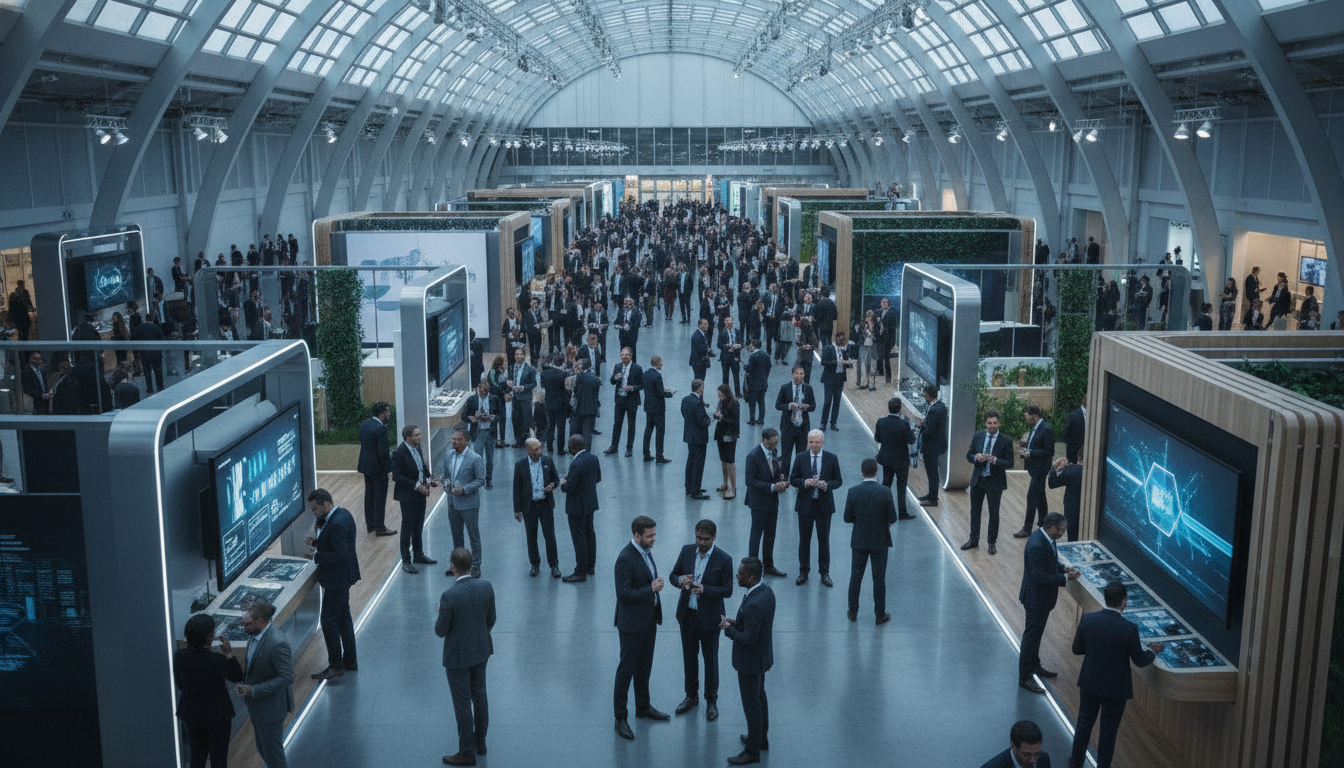
The initial six months of 2026 were packed with high-profile exhibitions, drawing millions of attendees and thousands of exhibitors across various sectors. These events spanned continents, from the innovation hubs of Las Vegas and Paris to the rapidly expanding markets of the Middle East and Asia, reflecting a truly global resurgence in face-to-face interaction. Below, we've compiled a snapshot of some of the most impactful events that shaped the first half of the year.
| Event | Dates | Location | Key Focus |
|---|---|---|---|
| CES (Consumer Electronics Show) | January 6–9 | Las Vegas, USA | Innovation, Product Launches, Immersive Tech |
| National Retail Federation (NRF) 2026 | January 11-13 | New York, USA | Retail Technology, Marketing Strategies |
| CONEXPO-CON/AGG | March 3–7 | Las Vegas, USA | Construction, Aggregates, Heavy Equipment |
| Hannover Messe | April 20-24 | Hannover, Germany | Industrial Technology, Automation, Robotics |
| Canton Fair | April 15–19 | Guangzhou, China | International Trade, Manufacturing |
| SNEC 2026 Solar PV & Energy Storage Exhibition | June 3-5 | Shanghai, China | Solar PV, Energy Storage Solutions |
January to March: Kicking Off the Year with Innovation and Industry Focus
The year began with a strong emphasis on technology and retail. CES (Consumer Electronics Show) in Las Vegas (January 6–9) once again set the tone for innovation, showcasing immersive tech and groundbreaking product launches. Hot on its heels, the National Retail Federation (NRF) 2026 in New York (January 11-13) gathered over 1,200 exhibitors to explore retail technology and marketing strategies. For the construction sector, World of Concrete (January 20–23, Las Vegas) offered hands-on demonstrations, while The International Builders' Show (IBS) in Orlando (February 17-19) highlighted residential construction trends.
March brought more specialized, large-scale events. CONEXPO-CON/AGG (March 3–7, Las Vegas), held every three years, stood out as one of the largest and most complex global trade shows for construction and aggregates. The natural and organic products industry convened at Natural Products Expo West (March 10–14, Anaheim), and industrial innovation took center stage at Global Industrie in Paris (March 30 – April 2), focusing on smart manufacturing and robotics.
April to June: Spring into Action and Summer Previews
As spring unfolded, the exhibition calendar continued its robust pace. April was particularly significant for industrial and design sectors. Hannover Messe (April 20-24, Germany) reinforced its position as a leading event for industrial technology and automation. Simultaneously, the Canton Fair (April 15–19, Guangzhou, China) served as a major international trade and manufacturing platform, while iSaloni / Salone del Mobile (April 21-26, Milan, Italy) once again defined global furniture and design trends.
May saw a focus on experiential marketing and wellness, with the Experiential Marketing Summit (EMS) in Las Vegas (May 18–20) exploring B2B and B2C brand activations. The first half concluded with several high-impact events in June, notably SNEC 2026 solar PV and energy storage exhibition (June 3-5, Shanghai, China), which affirmed its status as the largest global solar PV and energy storage trade fair, attracting hundreds of thousands and featuring major product launches. Art Basel (June 18-21, Switzerland) continued to be a premier event in the global art market.
Underlying Currents: Trends Shaping the Exhibition Landscape in H1 2026
Beyond the individual events, H1 2026 illuminated several transformative trends that are reshaping the exhibition industry. These shifts indicate a mature market that is strategically adapting to new demands and technological possibilities.
- Market Growth and Confidence: The UFI Global Exhibition Barometer (January 2026) revealed strong confidence, with 44% of companies expecting increased rented space and 33% forecasting profit growth exceeding 10%. While the U.S. market showed positive dynamics, dynamic regions like India, projected for 10% annual growth, and the Middle East, which contributed €3.8 billion to economic output, demonstrated particularly strong momentum. France notably rose to 3rd place in new industry rankings, surpassing Germany, reflecting evolving assessment frameworks that consider economic potential and business ecosystems.
- Technological Integration: AI and data-driven approaches were not just buzzwords but operational realities. Exhibitions increasingly leveraged AI for personalization, visitor behavior analytics, and matchmaking automation. AI tools were observed performing tasks like summarizing conversations, routing leads, and generating personalized content, enhancing both exhibitor ROI and attendee experience.
- Sustainability as a Standard: The industry's commitment to sustainability deepened, moving beyond aspiration to implementation. Events showcased modular recyclable stands, initiatives to reduce carbon footprints, and the widespread use of 'green' materials. This trend reflects a broader industry-wide effort to align with global environmental goals and meet stakeholder expectations.
- Hybrid Formats and Human-Centric Experiences: While technology advanced, the core value of live interaction remained paramount. Exhibitions effectively combined physical and online elements to achieve broader reach, but the emphasis was squarely on enhancing the human experience. Virtual and augmented reality served as powerful complements, enriching personal communication rather than replacing it.
- Flexible Structures: The adoption of modular and flexible exhibition structures gained traction. These adaptable designs not only offered cost efficiencies but also allowed for quicker customization to diverse event requirements, reflecting a responsive approach to dynamic market needs.
The first half of 2026 painted a clear picture of an exhibition industry that is not only recovering but actively innovating and growing. The blend of established major events with emerging regional powerhouses, coupled with a strategic embrace of technology and sustainability, positions the sector for continued success. As we look ahead, the lessons and successes of H1 2026 will undoubtedly inform the strategies of organizers and participants alike, driving future engagement and economic impact.
— End of Story —